My KISS fanaticism continued for a few years, but in early 1979, during my freshman year of high school, I was introduced to the music that would totally change my life. Shortly after Christmas break, one morning on the bus, I was talking with my friend Kevin about how I really liked some of this “new wave” stuff I was hearing on the radio, like Blondie’s “
One Way or Another
” and the Cars’ “
Just What I Needed
.” Kev’ told me that he had a few records I had to hear, and one day after school, I went over to his house. Kevin pulled an LP with a green, black and fluorescent orange cover, removed the vinyl from the sleeve and put it on his turntable, skipping to side two, track two, his favorite song on the album.
Drums, bass and guitars exploded in my ears, following a singer passionately exclaiming in a distinct, guttural British accent, “They offered me the office, offered me the shaaaaaa-op! They said I’d better take anything they gaaaaaaa-ot! Do you wanna make tea at the BBC, Do you wanna be, do you really wanna be a caaaaaaahp?”
“Listen to how angry he sounds!” Kevin instructed. And I listened. Oh, how I listened.

The song was “Career Opportunities” off of the debut album by
the Clash
, and thus I was ushered into the previously-dismissed world of punk rock. Granted, by 1979, the movement was almost over, and, being a 14 year-old white boy in suburban Pennsylvania, it’s not like I could relate to much of the political content, but the energy, the anger, the intensity was all ridiculously inspiring. Kevin loaned me that record as well as the equally incendiary
NEVER MIND THE BOLLOCKS, HERE’S THE SEX PISTOLS
to take home and get to know. Finally I had found music besides superhero themes that spoke to me. A few weeks later, I gave all of my KISS albums to my younger brother (a gesture I would later come to regret).
In short time, I was an avid fan of this music and began acquiring records by Elvis Costello, DEVO, Joe Jackson, the B-52’s, the Pretenders, Echo and the Bunnymen, the Specials, 999, the Romantics, XTC, the Psychedelic Furs and other bands that fell under this wide, but unifying anti-mainstream umbrella. For the first time, I felt a genuine, deep connection to rock and roll, and it started to change the way I looked at the world, as well as myself.
In December of 1979, the Clash released their third album,
LONDON CALLING
, a two record set that remains, to my mind, the single (or, technically, double) greatest rock album ever recorded (I usually don’t like absolutes, but this one I hold). I bought LONDON CALLING the week it came out—January of 1980 in the states—at the record department at Sears at the Park City Mall, and vividly remember showing it off to the friends I ran into at the Salad Haus.
On Thursday, March 6, 1980, I attended my very first rock concert: The Clash on the LONDON CALLING tour at the Tower Theater in Upper Darby PA just outside of Philadelphia. The ticket cost $7.50, and I went with my friends Kevin, Bill, Al and Nathan, as well as Kevin’s dad. We bought our T-shirts (including bootleg shirts outside the theater) and I got a copy of THE ARMAGIDEON TIMES "program" from the tour and we settled into our seats. Kevin's dad was cool enough to get a seat a few rows away from us so as not to cramp our punk rock style.
There were three openers: The B-Girls, a somewhat middling new wave combo and two reggae acts, Mikey Dread and Lee Dorsey. To say that the reggae acts were cooly-greeted is an understatement, but it points to how diverse and forward-thinking the band was. Finally, the rightly-tagged “Only Band That Matters” took the stage and tore into “
Clash City Rockers
,” beginning an hour and a half of incendiary punk magnificence.
At the time, of course, I had no idea what a big deal it was that I was seeing this band, at this time, on this tour. In fact, despite being near the back on the orchestra level, it was still so loud that I went to the lobby to sit out the encore, something that makes me wanna go back in time and kick my 15 year old butt back into the theater. But I couldn’t have predicted that over thirty years and literally thousands of rock shows later, as far as my concert history is concerned, nothing would ever measure up to number one .
Despite my worship of the Clash and the Pistols, I made a concerted effort to not refer to myself as a “punk rocker” mostly because I didn’t feel I deserved the honor… I wasn’t quite that downtrodden. Unless you count the non-stop abuse my friends and I received from our classmates for liking this music, an animus that even extended to the Police and U2, two bands that were in 1981 considered too freaky by the jocks and the preppies that were our arch-enemies.
In the Twenty-Aughts where, to quote Jane’s Addiction, nothing’s shocking, it’s hilarious to remember how the mere addition of a Dead Kennedys button to your sweater could garner you an afternoon in detention, as my friend Mike learned. Granted, it was a DK’s “
Too Drunk to Fuck
” button, but buttons and T-shirts didn’t have to bear profanity to garner us “punkers” (a much despised term) ridicule and abuse.

The day after seeing DEVO in Philadelphia on their
NEW TRADITIONALISTS
tour in 1981, my friend Bill and I wore our concert tees to school. But, as with most DEVO merch, these weren’t simple white shirts emblazoned with a logo; They were the same shirts worn by the band on the cover of that album, blue shirts with a black V-neck collar and black short sleeves. The left sleeve said “New Traditionalists” in red arcing letters over the face of an astronaut, and the DEVO logo was on the left breast in red and black circles. Yeah, they were kinda goofy. That was the point. But Bill and I received non-stop abuse the entire day (especially if we happened to be together at any point).
I also got loads of shit for the Go-Go’s baseball shirt I bought at their concert on the University of Pennsylvania campus a few weeks later, due to its fuchsia sleeves. My homemade B-52’s shirt, emblazoned with the line “I’m not no limburger!” drew much ridicule, and not due to the intentionally bad grammar. And the one day I wore a skinny new wave tie to my no-tie-required public school… you’d have thought I was walking around in a ballerina tutu. But to me, their rejection was a badge of honor.
The thing that made our social ostracism relatively easy to bear was that my friends and I (well, most of us, anyway) weren’t passive about this punk rock thing. We worked at it. It wasn’t easy to find this stuff back in those days before technology made everything instantly available. We’d buy Trouser Press and expensive imported copies of British music mags New Music Express and Melody Maker to read about new bands. We’d listen to the two local college radio stations, Millersville State College’s WIXQ and Franklin & Marshall’s WFNM and hope that the DJ would say the name of the band of that cool song we just heard so we could go to the mall or downtown to Stan’s Record Bar to try to find it that weekend (a number of my friends also made frequent drives to Philadelphia or Baltimore to go record shopping, but I only joined them once or twice).
One popular means of acquiring music that was not an option for the new wave fan was any of the record and tape clubs that advertised in seemingly every magazine in the 1970s and ‘80s. While the prospect of 13 LPs for 1¢ might have been enticing to the financially challenged teen, the selections left much to be desired if you were of the punk persuasion. An ad for the Columbia House Record& Tape Club in the August 1979 issue of PLAYBOY lists 259 selections (available on LP, 8-track, cassette or reel-to-reel). Of those 259, the only ones I would’ve considered buying at the time were The Cars’ selt-titled debut, Blondie’s
PARALLEL LINES
and
PLASTIC LETTERS
and Elvis Costello’s
ARMED FORCES
. That’s four out of 259, and by that point I think I owned all of those already .
Amazing as it is consider in 2011, I also discovered cool bands by watching SATURDAY NIGHT LIVE. The Monday after the B-52’s performed “
Rock Lobster
” and “
Dance This Mess Around
” on SNL in 1980, my friends and I convened before homeroom to discuss how mind-blowingly awesome they were as most of our classmates derided the Athens band as “weird,” “stupid” and that most suburban of pejoratives, “gay.”
The ridicule extended beyond my classmates. One particularly notorious event occurred at the one and only “Bring Your Own Records Dance” held at my high school. Barely anyone who attended the thing dragged their heavy vinyl along, but my friends and I did, and so GJ the DJ (no, really) was obligated to play some Buzzcocks and Rezillos, to which we merrily pogoed on the squeaky gym floor.
Until one of the teacher chaperones, Mr. Meany , came up to our little group of new wavers and said that no more of our records were going to be played. Stunned, we asked why, as we were practically the only people who were actually dancing at the “dance.”
“You guys aren’t dancing. You’re doing THIS,” Mr. Meany said as he, I shit you not, bolted forwards and slammed his shoulder into me, knocking me backwards. My friends stood stunned as I regained my footing only to have him slam into me again, repeating his judgment (I wonder if he’s a fan of SO YOU THINK YOU CAN DANCE these days).
Somehow, probably because I was a giant wuss, I was able to maintain my cool and pointed out that we weren’t even gently slam dancing, that our skanking and jumping may have been unusual in the eyes of those who only did the grinding, hand-on-butt slow dancing, but was totally harmless. Even at the time, I realized that Mr. Meany was trying to get me to physically retaliate so he’d have a legitimate reason to eject us from the dance, but, despite a steady diet of superhero vengeance coursing through my psyche, I refused.
Instead, we just took our records and sat on the bleachers, feeling righteous indignation over the breadth of our ostracism from the mainstream. Fuck this school, basement parties were way better anyway.
And we did have basement parties. I’d drag my stereo and records to the basement and set them up on the washer and dryer, move the piles of boxes out of the way and make room for my pals and I to pogo around the metal poles to Black Flag and Dirty Looks and GenX. As I was a non-drinker in high school (although I never applied the term “straightedge” to myself), my friends would do their illegal imbibing outside throughout the evening.

Towards the end of my senior year in high school I started a relationship with one of the girls in our little punk clique (It was her Elvis Costello t-shirt that first caught my eye, and for that reason I shall refer to her as Alison). Our punk rock devotion was the main thing that Alison and I had in common, much to her parents’ chagrin. They far preferred her prior boyfriend, a conservative, slightly older guy who worked in a bank and hated the music Alison listened to. Of course, her parents didn’t know that he was also a giant cokehead, but I have a feeling that even if they had, they still would’ve liked him more than this rebel-rousing “punker.”
Due to this disdain, Alison’s parents refused to allow me to take her to our senior prom, which was actually okay with me, as the prospect of renting a tux to dance to Journey songs didn’t exactly thrill me, nor most of my other pals. And so we planned our own unofficial prom. We got dressed up in our new wave finery and had a fancy-schmancy dinner at a downtown Italian restaurant before adjourning to my parents’ basement for some formal slam dancing. Man, how I wish I had photos of that event, especially after it was crashed by a bunch of people who ditched the official prom to come join us in the basement.
See, a funny thing happened during the last semester of my senior year. All of a sudden, this new wave / punk stuff started to become a little more popular, thanks in part to this new cable channel called “MTV,” which stood for “Music Television” and showed these things called “music videos.” And since new wave bands were practically the only artists who had videos ready to go when the network premiered, suddenly acts like the Buggles, Wall of Voodoo, DEVO and Siouxsie and the Banshees were getting wider exposure than ever they had ever dreamed possible.
And suddenly, the popular kids at Hempfield were hosting “Punk Parties,” where they’d, at least for one night, stick safety pins in their polo shirts and spike their hair and play music that just a year earlier was deigned unfit for human consumption. Of course, they didn’t go out and BUY any new wave records, they just asked to borrow them from one of my punker peers. I never, ever agreed to loan any of my precious vinyl to any of these posers, and not just because they STILL wouldn’t have invited me to the party.
Finally, in June of 1982, I graduated from high school, and while our official graduating class song was Bette Midler’s “The Rose,” for me it was the Clash’s “
Clampdown
,” with its empowering message, “Let fury have the hour / anger can be power / do you know that you can use it?”
________________________________________________________________________________________
from the forthcoming book, COLLECTOR'S EDITION: Confessions of a Pop Culture Obsessive-Compulsive
by and © Karl Heitmueller Jr.

 has been a sometimes anachronistic symbol of a simpler time, when good and evil were more black and white, when patriotism didn’t carry a sheen of arrogant jingoism. In the 1970s, Steve Rogers, like many others in the “Me Decade” spent a lot of time trying to “find himself,” but at least Steve had a good reason to feel lost. After all, he had only been unfrozen from that ice for a short time. If you have no idea what I mean, you will after CAPTAIN AMERICA hits the theaters this weekend.

 (Oct. 1970) by Marie Severin & Joe Sinnott
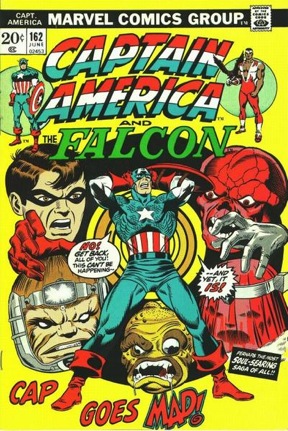
 (June 1973) by Jim Starlin and Joe Sinnott
 CAPTAIN AMERICA #255
 (March 1981) by Frank Miller & Joe Rubenstein
In the early ‘80s, writer Roger Stern and artist John Byrne had a memorable run on CAP, during which he actually ran for President. This 40th anniversary issue retold Cap’s origin and featured this cool retro cover by Frank Miller (way before he became a batshit parody of himself).
(March 1981) by Frank Miller & Joe Rubenstein
In the early ‘80s, writer Roger Stern and artist John Byrne had a memorable run on CAP, during which he actually ran for President. This 40th anniversary issue retold Cap’s origin and featured this cool retro cover by Frank Miller (way before he became a batshit parody of himself).


 in the 21st century. Technology has allowed corporations to finally perfect the kind of marketing begun by car companies in the 1950s, where the consumer is made to feel inferior if they hang onto their out-of-style OLD thing (durability notwithstanding) because this year’s model is so much nicer… and it has tailfins!

 look like
  What’s that, Slim? You’re going to wear your cuffed jeans with your motorcycle boots and your black T-shirt tonight? With the mechanic’s jacket or the leather one? Ah, great choice! Don’t forget the pomade and Marlboros!


 of most iconic superheroes is Superman, Batman and Wonder Woman. But who’s #4 in the DC Universe? Until now, it’s been kind of a toss-up between
  and
and  , but after this weekend, the scales may tip in GL’s balance with the release of Martin Campbell’s
  as a science fiction hero, our space sector’s chosen recruit for an intergalactic peacekeeping force, the
  . As written by John Broome and drawn by
  , Green Lantern was one of the key figures of the 1960s Silver Age superhero renaissance.
 ) indicated that the times were (yes, I’m going to say it) a-changing. DC Comics was being infused with—some veterans said taken over by—fresh, idealistic young writers like Denny O’Neil, who took over the title with this issue. Using the comic as a platform to tackle social and political issues, O’Neil paired GL (depicted as a conservative symbol of the establishment) with Green Arrow, who had recently been revamped from a mere Batman clone into a radical, van dyke-sporting leftist. Along with
  and a member of the Guardians of the Universe (who oversee the GL Corps from the planet Oa), the “
 ” crossed America in a beat-up pickup truck, tackling such Earthbound issues as environmental abuse, racism, poverty, sexism and, most startlingly, drug abuse.
 was one of the first superhero comics to push the boundaries of the formerly staid genre, ushering in the Bronze Age of Comics. In GL #87, John Stewart was designated as the new sub for Hal in case of emergency, becoming one of the first African-American superheroes.
  and
and  ’s realism-based illustrations further signaled a change in the medium. And while the series only lasted until #89, its impact has never gone away.


