Showing posts with label 13th Dimension. Show all posts

Thursday, May 20, 2021

13 Reasons to Watch the 1970s WONDER WOMAN

I recently finished a re-watch of the 1975-79 WONDER WOMAN TV series, which I purchased on DVD in 2004 because that was just what we did back then! But as with so many of my Blu-rays and DVDs, the three season box sets mostly sat on my shelves gathering dust, until Covid quarantine made all this hard media again seem like a great idea. After just over two months of (mostly) nightly viewings, I finished all 60 episodes (counting the TV movie pilot) and have some notes. Is the show perfect? It was a 1970s TV superhero show, of course not! But there are many reasons to watch, some snarky, some not. Here are thirteen of them. 

13. RECYCLING RECONSIDERED
In the pre-recycling days, apparently everyone just left dozens of giant, empty cardboard boxes stacked up everywhere. Which is lucky for the villains of the 1940s and the 1970s, who had nice, soft cushioning for those times when Wonder Woman threw them through the air (which was pretty much every episode). Remember this the next time you’re folding up those cartons to stick in recycling… is there a chance you might be tossed like a rag doll across your garage? Might wanna hang onto some of those assembled Amazon boxes (pun intended). 

12. SPONSORED BY L’EGGS (SPOT THE PANTYHOSE)
In both pilots (the 1975 ABC TV movie and the 1977 CBS reboot), you might notice something strange about the Amazons of Paradise Island… despite living in a feminine utopia, away from the trappings and edicts of a patriarchal society, they’re all wearing… panty hose?!? Even on the beach! This unlikely fashion choice would follow Diana to her life in “Man’s World,” where she not only wears stockings as Wonder Woman, but in every possible scenario…. even with a bathing suit at the swimming pool or a nightgown at bedtime or in a tropical jungle! Heck, she probably even has them on under her diving outfit!

WONDER WOMAN was hardly the only culprit in this era, where TV pretty much eschewed bare legs on everyone. Chrissy Snow and Daisy Duke (look ‘em up if you have to, Gen-Zers) both wore stockings with hot pants and high heels. But to watch it in the 21st Century, the abundance of redundant—and no doubt uncomfortable—hosiery is rather distracting (if you’re inclined to pay attention to things like legs). 

11. PLAY “SPOT THE 1940s ANACHRONISMS”
In the first, WWII-set season, the show paid attention to era-appropriate costuming and hair for the principal actors. The guest stars… not so much. As with HAPPY DAYS (set in the 1950s and early ‘60s), once the era was firmly established, that kind of verisimilitude kinda went out the window. Watch for Nazis sporting ‘70s shag haircuts and sideburns or a kidnaped scientist’s suit that looks like it came from the wide-lapelled Johnny Carson Collection. Also, for bonus points, watch the background for 1970s cars, airplanes, and signage! (My favorite anachronism: In the pilot film, an unattended newsstand displays a copy of SUPERMAN #261, cover dated Feb., 1973!)

10. LYLE WAGGONER’S EARNESTNESS
Poor Lyle Waggoner. He never got the girl. The romance between Major Steve Trevor and Wonder Woman that was building in Season One got chucked out the window once the show shifted to the modern day and Waggoner began playing the son of his 1940s character. Presumably, the producers thought it might be creepy for Diana to hook up with her old flame’s offspring, and they weren’t wrong. But as the show went on, Trevor not only lost out on romantic action, but all other kinds as well, as he eventually became an IADC desk jockey, shuffling papers instead of socking bad guys in the jaw alongside Wonder Woman. Still, Waggoner never stopped portraying Trevor (both of ‘em) with anything less than 100% square-shouldered earnestness. And just look at those gleaming teeth! 

9. SUPER POWERS WITH ACCOMPANYING SOUND EFFECTS
Most of Wonder Woman’s powers (which she derives from Aphrodite’s Magic Girdle… er, Belt, and does not have when she’s Diana Prince) are accompanied by super ‘70s sound effects, just to remind the viewer that this is not Normal Woman. 

Of course, there’s the spinning transformation from Diana to Wonder Woman (with accompanying non-diegetic explosion). She can’t fly, but she can leap tall buildings—as well as gardens, fountains, cars, construction equipment, and any other structure bigger than a bread box—in a single bound (with accompanying ascending / descending exaggerated whizzing sound). She’s super strong (any person or item thrown by Wonder Woman moves so fast it creates a whooshing sound only slightly less subtle than that of George Reeves’ Superman taking off in flight) and able to deflect bullets with her Amazonian bracelets (the sparking ricochet effect set off by triggers concealed in Lynda Carter’s fists, but you knew that, didn’t you?). She can run really fast (over ten miles a minute according to a late S2 episode), even sometimes in high heels (see #3)! She can force people to tell the truth and do what she says by ensnaring them in her magic lasso (which somehow emits computerized bleeps and bloops during this procedure). She can use her tiara as a boomerang, and can perfectly impersonate anyone’s voice. 

Oh, and, like Dr. Doolittle, she can talk with the animals (whether or not she can walk with the animals, grunt and squeak and squawk with the animals remains to be seen).

8. GUEST STARS A-GO-GO
Both the ABC and CBS shows’ guest star roster reads like a 1970s-themed trivia game. Robert (Mike Brady) Reed (with ‘70s ‘stache and turtleneck in 1942)! Lance (JAMES AT 15/16) Kerwin! The great Cloris Leachman camping it up like she’s in a BATMAN episode! Gary “Radar O’Reilly” Burghoff (Lynda Carter’s cousin)! Kenneth Mars (taking time off from Mel Brooks movies)! Popular mime duo (you read that correctly) Shields & Yarnell! Pop idol Leif Garrett (in two roles! And still with hair!)! LAUGH-IN’s Henry Gibson (sadly not reciting poetry)! Martin Mull as a flute-playing rock star / magician / thief (who sang the songs in the episode himself!)! And of course, “Introducing Debra Winger” as Diana’s sister, Drusilla, aka Wonder Girl (in a perfectly awful costume)! Whew! All that’s missing is Jimmy “J.J.” Walker and Charo! 

7. THE ALTERNATE SUITS
Okay, first, let’s agree that the “real” Wonder Woman costume is spot-on, a near-perfect realization of the comic book outfit. Sure, the bullet-bra and giant shorts of Season One can look a little weird if you stare too much (STOP IT!), but when the show moved into the 1970’s designer Donfeld’s costume looked better than anything we’d ever seen in a comic book adaptation (with the possible exception of Tom Tyler’s Captain Marvel suit in the 1941 serial).

But whenever Diana needed to make use of alternate transportation or do some diving, a second spin brought about alternate costumes that haven’t exactly stood the test of time. The “Scuba Suit” (complete with flippers once Diana hits the pool, er, ocean), which also doubles as her biker outfit (with added star-spangled helmet) feels more like something Cathy Lee Crosby would wear in the original, ill-fated 1974 telefilm). The single-use skateboard ensemble features knee and elbow pads (are they even necessary?) that just look silly. But no alternative outfit is more eye-rolling than the conservative, flesh-covering riding outfit that Roy Rogers insisted Lynda Carter wear in the western-themed Season One episode, “The Bushwhackers.” Practicality has no place in superhero shows, Roy! 

I do like the cape that Wonder Woman wears to formal functions, though. 

6. WEIRD GEOGRAPHY
Thanks mostly to production budget restraints, WONDER WOMAN couldn’t hide mountains (or palm trees) in the background in location shots that were supposed to be Washington DC or other East Coast settings. Lots of California-shot TV shows up through this era just kind of ignored this unavoidable snafu, mostly because nobody thought anyone would be repeatedly re-watching these shows in their homes on hi-def TVs! WE DIDN’T KNOW THE FUTURE! 

Towards the end of S3, there was a one-off episode that indicated Diana was being moved out to the west coast branch of the IADC (and being given a new supporting cast including a smart-alecky kid, an ersatz-Bionic Man, and a chimpanzee!), but by the next episode, she was back in DC with Steve Trevor. Would a fourth season have eliminated both Steve Trevor and the geographical flubs (as well as taken away Diana’s frequent flyer membership)? We’ll never know. 

5. “FUTURISTIC” TECH
The invention of the “Inter-Agency Defense Command” was actually a good way to allow Steve and Diana to get involved in all manner of national and international crime and espionage. But the agency’s tech has aged about as well as any computers of the era. The enormous, info-gathering, room-filling IRAC computer (nicknamed “Ira”) utilized a robotic voice straight out of a 1950s Sci-Fi B-movie. Even more laughable is the small, roving computer (named “Rover”) that delivers mail and other small items like glue and passports actually speaks the Looney Tunes’ Road Runner’s “Beep Beep” as he rolls down the hallways of the IADC (via being pulled with a very visible wire). Damn thing makes Twiki look like The Terminator. 

But the IADC computers come off better than the supercomputer in the S2 episode, “IRAC is Missing,” as the machine displays its wiped memory by literally saying, “Uh, um… er, uh…” Evil robots fared even worse, often looking like they were constructed out of some of those leftover cardboard boxes, dryer hoses, and silver spray paint. 

And while we’re at it, even Lynda Carter admits embarrassment over Wonder Woman’s invisible jet, a plastic model in which we can see a translucent seat (in which an obvious WW doll sits) and center stick, but no engine! It does, however, come with piped-in elevator muzak, making WW’s urgent missions feel like a jaunt to a Beaches resort. 

4. 70’S UP THE WAZOO
THE NEW ADVENTURES OF WONDER WOMAN might not be the MOST Seventies show ever (I’m going with THE CAPTAIN AND TENNILLE or ALL IN THE FAMILY), but there’s enough iconography to keep any fan of that era spellbound: The (mostly) giant, lumbering CARS: Buick Skylark, Lincoln Continental, AMC Matador, Cadillac Coupe DeVille, Chevy Chevelle Malibu, Bel Air, Nova, Monte Carlo, and Camaro, Ford LTD and Gran Torino, Pontiac Firebird, heck, there was even a dune buggy!!; FASHION: Enormous, oversized glasses, bell-bottoms wide enough to camp in, platform shoes, floppy hats, satin jackets, peasant blouses, fat neckties, and wiiiiiiide collars!; FADS: skateboarding, disco, glam rock, UFOs, computer dating, and, uh, gymnastics (on more than once occasion, Wonder Woman leapt onto mysteriously-placed, high-hung parallel bars to do a quick routine while spellbound evildoers stood and gaped until the heroine dismounted right into them!). Oh, if only there were a punk episode of WONDER WOMAN. 

3. COSTUME CONTINUITY ERRORS
Let’s just say it’s a good thing this isn’t a drinking game. First, there’s the inconsistency of Diana’s Golden Lasso, whether it suddenly turns into a fat, brown rope, or grows to hundreds of feet long (I mean, it is magic, so you could argue this is not a continuity error, but let’s just go with it). 

But the most common costume continuity flub concerns Wonder Woman’s red-and-white boots, which switch from heels to flats numerous times in every single episode. Obviously, this depends on whatever stunt is being performed (sometimes she runs in heels, sometimes not, but she never, ever does a super-leap in them). Which raises the question, why bother with the heels in the first place (aside from the obvious trope)? The character didn’t always wear heels in the comics, the 5’10” Carter didn’t need them to appear statuesque, and wouldn’t it be a nice feminist touch to have Wonder Woman in flats? 

2. THE THEME SONG
I’m just gonna go ahead and say it: There is no better superhero theme ever written. Oh, sure, some can sidle up alongside it… the 1960s SPIDER-MAN cartoon theme, BATMAN 1966, John Williams’ majestic SUPERMAN theme. But are any of those as unshakeable an earworm that Charles Fox and Norman Gimbel’s supremely catchy theme? And there are four different versions (I’m partial to the funked up final version from S3, even though I do miss the lyrics). C’mon… “In your satin tights / fighting for our rights / and the old red, white, and blue?” That’s WAY better than “Batman / Batman / Batman / BatmanBatmanBatman!” C’mon admit it… the WW theme is stuck in your head now, isn’t it? You’re welcome! 

1. LYNDA CARTER
Okay, time to get serious. Because the main reason to watch the three seasons of WONDER WOMAN is… obviously…. Lynda Carter. Not to put too fine a point on it, but she was absolute perfection as both Diana Prince and Wonder Woman. She’s every bit as good as Christopher Reeve playing Superman (and she beat him to the punch by a few years). And it’s not just that Lynda looked the part. Like Reeve after her, she underplayed Wonder Woman, allowing the costume to convey the Wonder while she focused on the Woman. Also like Reeve, Carter had a gravitas and maturity that belied her young age (both actors were in there early 20s when they first put on the costumes). Rising above even the cheesiest special effect or lamest plot, Carter made every episode worth watching. Regardless of whether you first saw her as Wonder Woman on Friday nights on CBS in the ‘70s, or in reruns on cable in the 2000s, or in a YouTube clip just last week, it’s hard to argue that (all due respect to Gal Gadot, who is admittedly great in the role), Lynda Carter will always be the definitive live action Wonder Woman. 

But speaking of the heir to the tiara, here’s one more reason to watch Lynda Carter’s WONDER WOMAN: To maybe appreciate Gal Gadot’s much-maligned WONDER WOMAN 1984 just a little bit better. I remain convinced that director Patty Jenkins’ intention with the ill-received 2020 sequel was to pay homage to the glorious cheesiness of not just this series, but all action / adventure /superhero shows of the 1970s / ‘80s. If you look at WW84 in that context, treat it as a big budget episode of the TV show, it actually works a little better (a little) than if you simply compare it to the admittedly far superior 2017 WONDER WOMAN. 

Because let’s face it, as much as we love them, superheroes…. Are goofy. Godlike beings in skintight costumes fighting bad guys, most of whom don’t stand a chance against them? Regardless of how many coats of angst or black we paint on them, it’s ultimately a kid’s fantasy that we, as adults, enjoy nonetheless. Because as WONDER WOMAN (the show) reminded us week after week… it’s inspirational, it’s cathartic, and mostly, it’s an awful lot of fun. 


NOTE: This piece was originally posted on 13th Dimension. 
You can watch WONDER WOMAN streaming on HBO Max, on Amazon Prime, or on DVD.


Friday, February 26, 2021

The Squeak of the Spinner Rack

NOTE: This piece originally ran as part of 13th Dimension's ongoing series of Retro Hot Picks, spotlighting comic books on the rack in a selected month from the past. Dan Greenfield asked me to contribute to the post concerning books cover dated April, 1970 (which hit the stands in February) because he knew that was the very month I started reading comics. That may seem like very specific knowledge for someone to have about me, but there's a reason why (aside from the fact that I've blathered about it before). I've augmented the piece with additional art from the books described. 
----------------------------------------------------------------------

One day in February of 1970, my father handed me something he’d picked up at the newsstand on the way home from work. He knew that I was a big fan of Superman (primarily from the Filmation cartoons that were at the time in reruns on CBS Saturday mornings), so he thought I might enjoy a comic book starring said character. Technically, it was the younger version of the hero, as the book was SUPERBOY #164, cover dated April 1970. My poor Dad, with this simple fifteen-cent impulse buy, had no idea of the Pandora’s Box he’d just opened for his five-year-old son. I became instantly smitten with the medium of comic books, and later that week, my mother took me to the Thrift Drug a few miles down the road from our suburban cul-de-sac and directed me to the comic book spinner rack near the front of the store, allowing me to pick out a couple more samples of this new interest of mine.

Anyone reading this is at least familiar with what an old spinner rack looked like—four vertical rows of up to ten wire baskets that held about a dozen or so books each. The rack rotated (hence the “spinner” part of its name) so that it could be placed in a corner or against a wall in and still allow for complete mining of the full field of pulp. Now, if you’re too young to have ever had the experience of foraging a comic book spinner rack, let me try to paint a picture. 

I can remember the rush I felt like every time I entered a drug store or a newsstand and saw a freshly-stocked comic rack. The overwhelming palette of color and bold imagery was an adrenaline jolt like few things I’ve felt since. I’d rush to the fixture and begin the scavenging, carefully flipping the tops of the books in each basket (most of which housed more than one title, which is why comic book mastheads contained as much information as possible, something that can look redundant from a design perspective in the 21st century but was necessary in context), picking the new issue of books I bought regularly and always trying out a new title if the cover grabbed me. 

I can still hear the squeak of the rack as I turned it to peruse the next row, squatting as I got to the lower baskets, standing up when I finished the vertical drop. I still remember the thrill of finding something I wanted hidden behind some issues I didn’t (romance comics, yuck!). I can recall the pile of comics growing in my sweaty little paws, the dimes, nickels, and quarters adding up with each selection (DC Comics mostly, but I bought from almost every publisher in the ‘70s), hoping that Mom or Dad was feeling extra generous that day and wouldn’t make me put some of them back (they rarely did). The only bad thing about the spinner rack was when you had to share it with another comic book fan (Hey, don’t spin it, I’m not done with this row yet!) Or when you could tell that the stock boy whose job it was to put out the new books didn’t care whether or not they got beat up in the process. But I can honestly say that of all the ways I’ve purchased comic books in the half-century (ouch) since that first issue—comic shops, subscriptions, conventions, used book stores, online—nothing was ever better than hitting the drugstore spinner rack. 

Anyway, back to that February day 51 years ago… Here are the books I picked out that day (and forgive my near-single-mindedness): ACTION COMICS #387, SUPERMAN’S PAL, JIMMY OLSEN #128, DETECTIVE COMICS #398, and SUPERMAN #225. Every one of these books (along with SUPERBOY #164) holds a place of distinction in my collection; they are not filed away in the comic boxes with their alphabetical / chronological brethren, they are on open display on a shelf in my studio, and the covers of each one resonate with me like pictures of any first loves. 

What I didn’t come to understand until many years later was the significance the timing of my entry into comic book fandom held. Also on the spinner rack that week was GREEN LANTERN #76, widely considered to mark the very dawn of the Bronze Age of Comics. So I started buying / reading / collecting comics the precise moment that my favorite era of the medium began. Looking at the gallery of all the comic books that came out that month (many more of which I’ve since added to my collection), I am again reminded that while I may often feel the sting of middle age, I wouldn’t trade the experience of buying these books at this time in this manner for anything. I am a true Bronze Baby and I wouldn’t have it any other way. 


House ads from these comics that mesmerized me!

Friday, December 04, 2020

Glows in the Dark

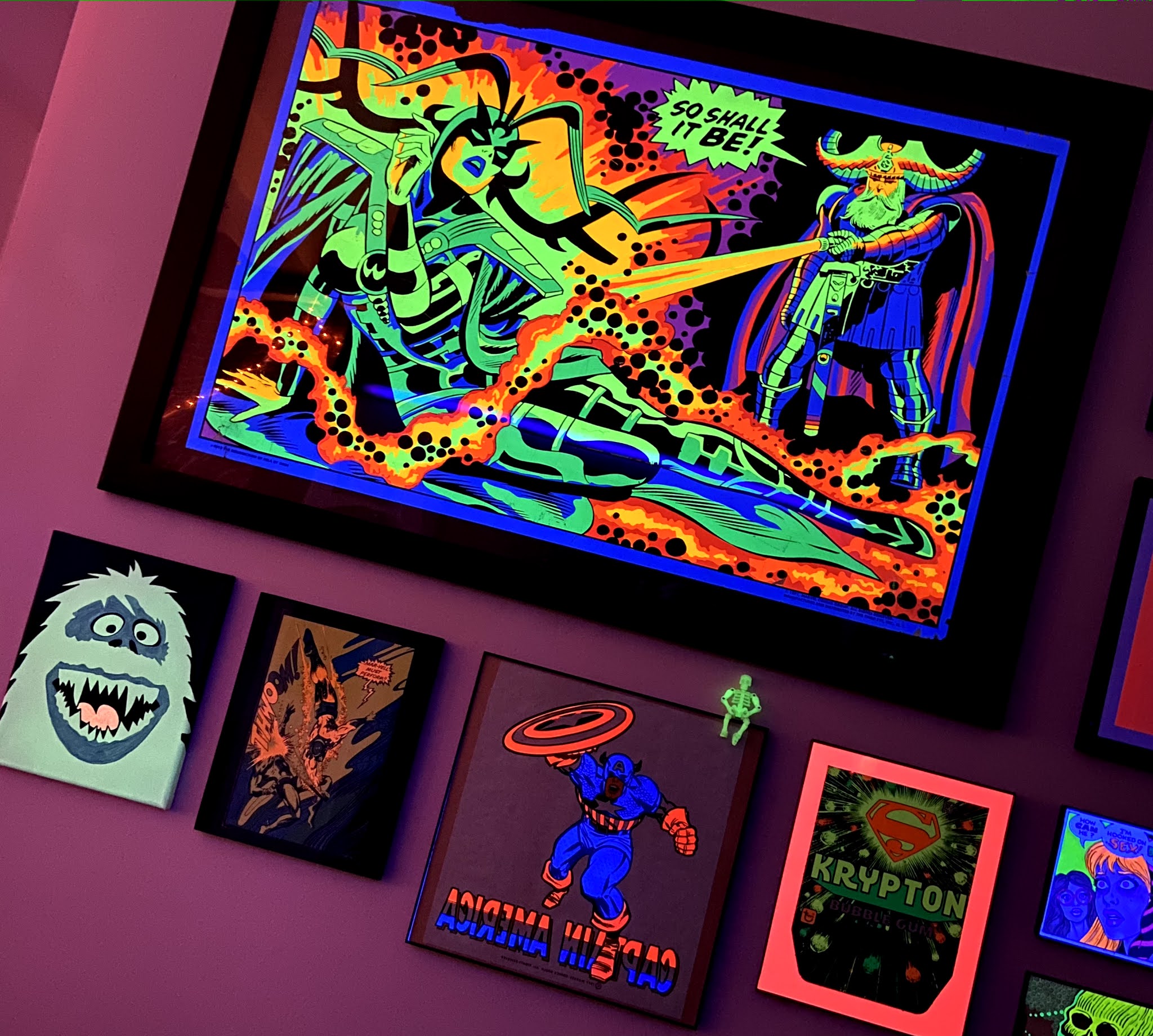
While way more commonplace than in decades past, adult toy collectors still face a certain stigma amongst the general public for a continued passion for things usually thought of as juvenile and best left in childhood. I live in a home that’s filled with geeky ephemera: thousands of comics and graphic novels, framed superhero and movie posters, shelves and boxes full of action figures, and more. But there’s one thing (actually, two) in my apartment that has drawn maybe more eye-rolls than even my display of hundreds of Superman toys: Two working black lights, one four-foot fluorescent tube hung in the hallway (“The Black Light Gallery,” as I call it) and a smaller one tucked away behind a speaker in the living room. Both of them are on more often than not, illuminating chosen aspects of my beloved collection of glow-in-the-dark and fluorescent toys and artwork. 

I’m not sure when exactly my phosphorescence phixation—er, fixation—began, but I think it may have been with Pro Arts’ Kryptonite Rocks. Released in 1977, packaged in a box with a redrawing of the classic Wayne Boring Superman pose from Superman #53, these were simply chunks of white quartz rock covered with green fluorescent paint. But they instantly became one of my favorite pieces of Superman merch. 


Around the same time, one of the neighbors, a married guy in his mid-20s, was starting to cast off the trappings of his youth, and selected teenage me as the lucky recipient of some of this stuff. One of the things he gave me was his four-foot black light fixture, which no doubt illuminated some fun times during his college days as an engineering student (he also gave me a big stack of early-1970s Playboy Magazines, but that’s another story!). I put the black light in the window sill in my bedroom where it served me well as the visual complement to my punk / new wave-fueled angst during high school. 


I painted my walls gray (much to the consternation of my mother) and covered the ceiling in glow-in-the-dark stars. I had a handful of black light posters, of course: The Marvel Third Eye Hela beauty (one of my most prized possessions to this day), A Christopher Lee Dracula poster from Dynamite Magazine, and a felt Capricorn poster, to name a few. I covered the windows in paper decorated with band and superhero logos hand-painted with fluorescent paint (I feel like I have to add that I abstained from one enhancement normal associated with this esthetic… I was not then—nor ever—a stoner. I got enough of a buzz just from the visual stimulation of this stuff [aurally abetted by the Psychedelic Furs, Lene Lovich, and Echo and the Bunnymen, to name a few]). 

Curiously, the black light did not follow me to college, nor to my early apartments as I became an adult. It wasn’t until I got divorced at the age of 30 and moved to Hoboken NJ with my friend Rob that I resurrected this particular aspect of my arrested adolescence. I bought a small 12” black light and hung it in the small, enclosed passageway between the living room and bedrooms in our little railroad apartment. CD shelves lined the three-foot space, onto which I also placed some glow-in-the-dark toys. I framed and hung the fluorescent box top from Topps’ 1979 Krypton Bubble Gum and strung the glow-in-the-dark pirate skeleton that was a Cap’n Crunch premium in 1978 from the ceiling. But it wasn’t until two apartments and a decade or so later (after another relationship ended) that I deep-dove back into this particular aspect of my adolescence, hanging a new four-foot fixture in the hallway, across from a gallery of fluorescent posters and artwork (Hela once again basking in the full-on glorious glow of the black light). 


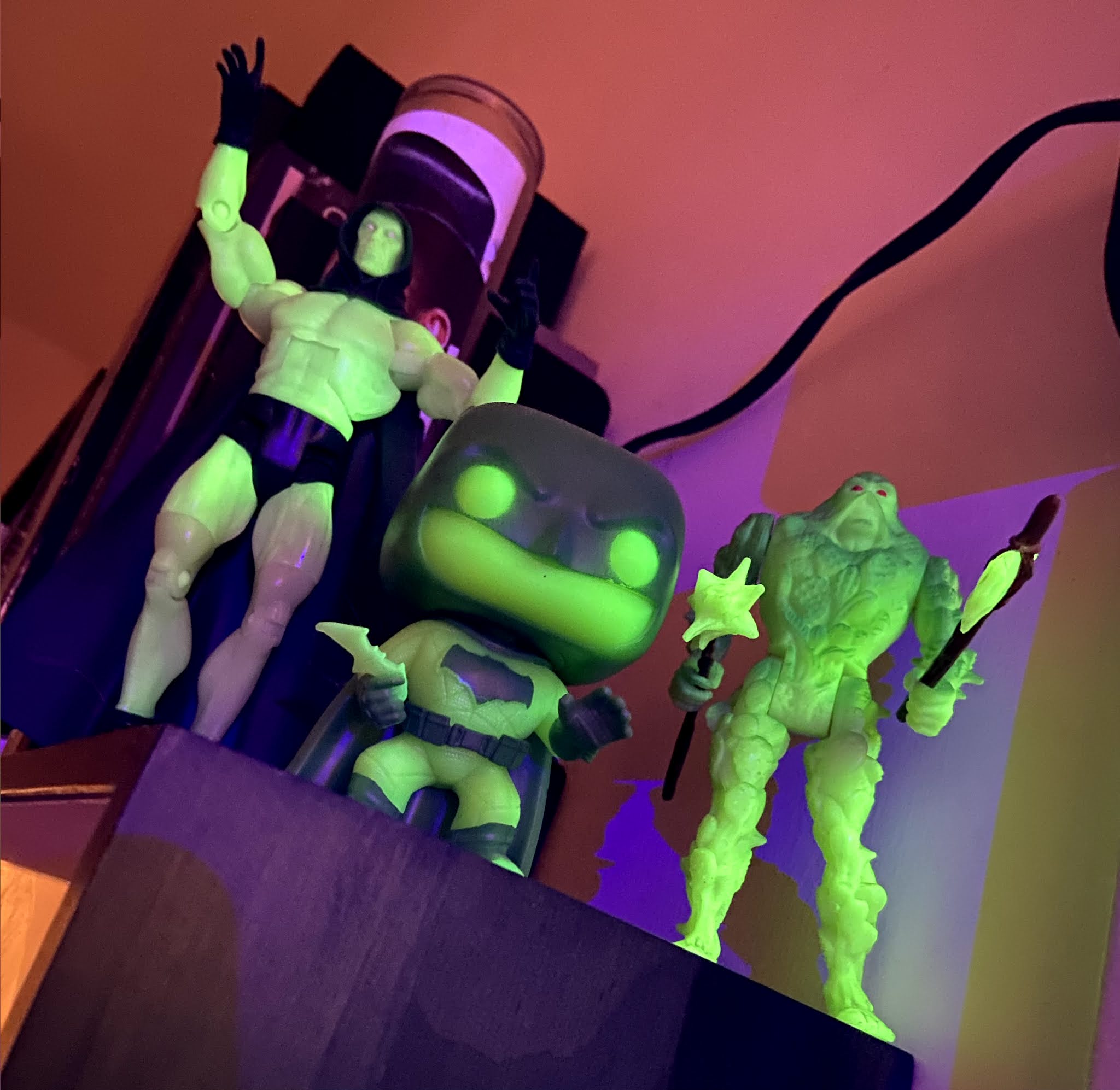
But back to the toys: Aside from the ubiquitous skulls, skeletons, and super balls, there have been some instances of crossover between my comic book fandom and my affinity for glow-in-the-dark stuff: Kenner’s 1990 “Bio-Glow Swamp Thing” action figure (tying in with that awful animated series). A glowing Casper from a 1974 Cootie game (which lives in my guest bath). Two different figures of The Spectre (the 2000 DC Direct figure with him floating above the elongated cape is one of my favorite action figures ever). The 2007 Justice Lex Luthor figure is augmented with glowing capsules on his uniform. And, despite a deep antipathy towards Funko Pops, I couldn’t resist the Batman V. Superman glow-in-the-dark two-pack (even though they barely glow, darnit). 


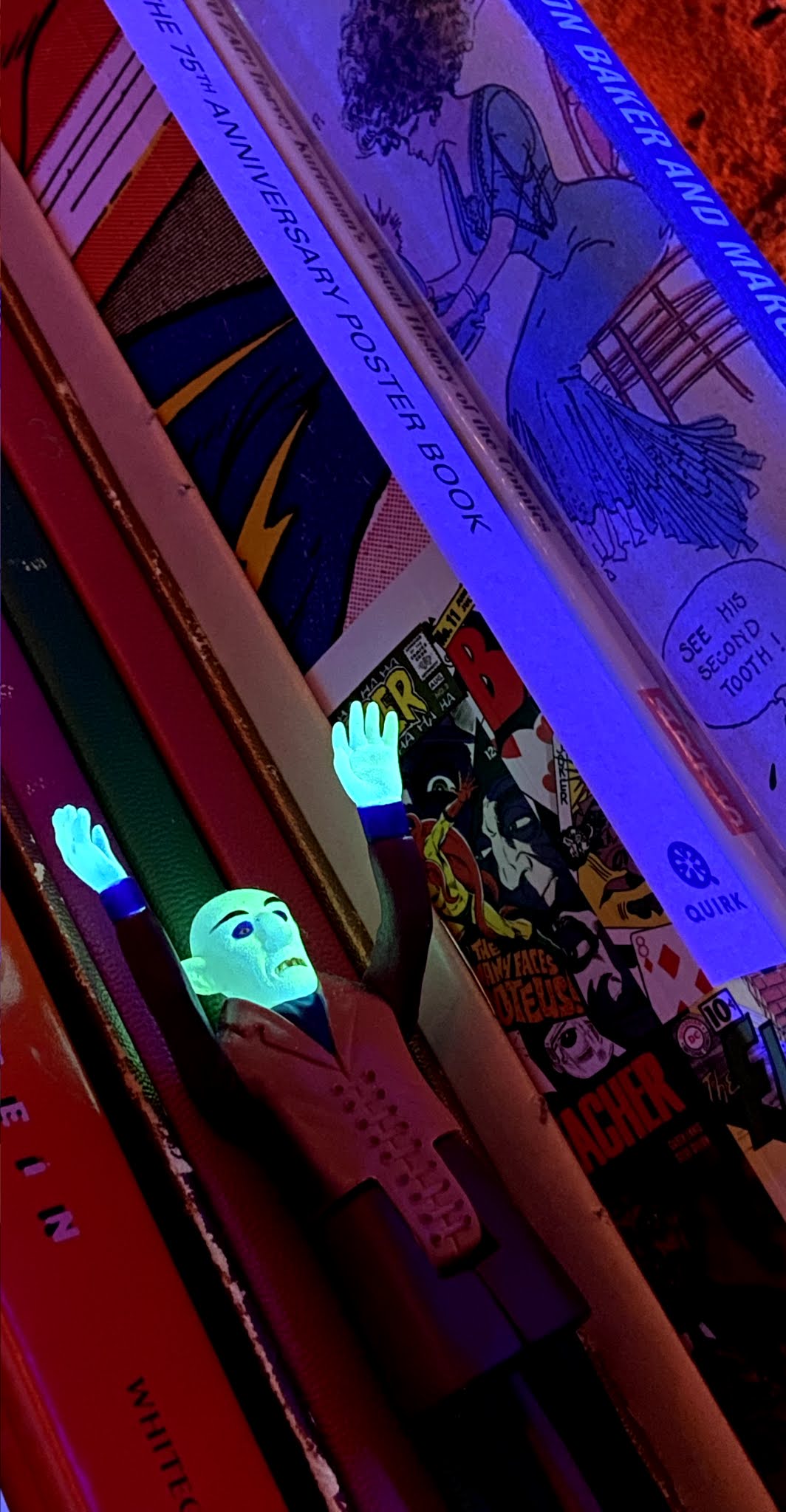
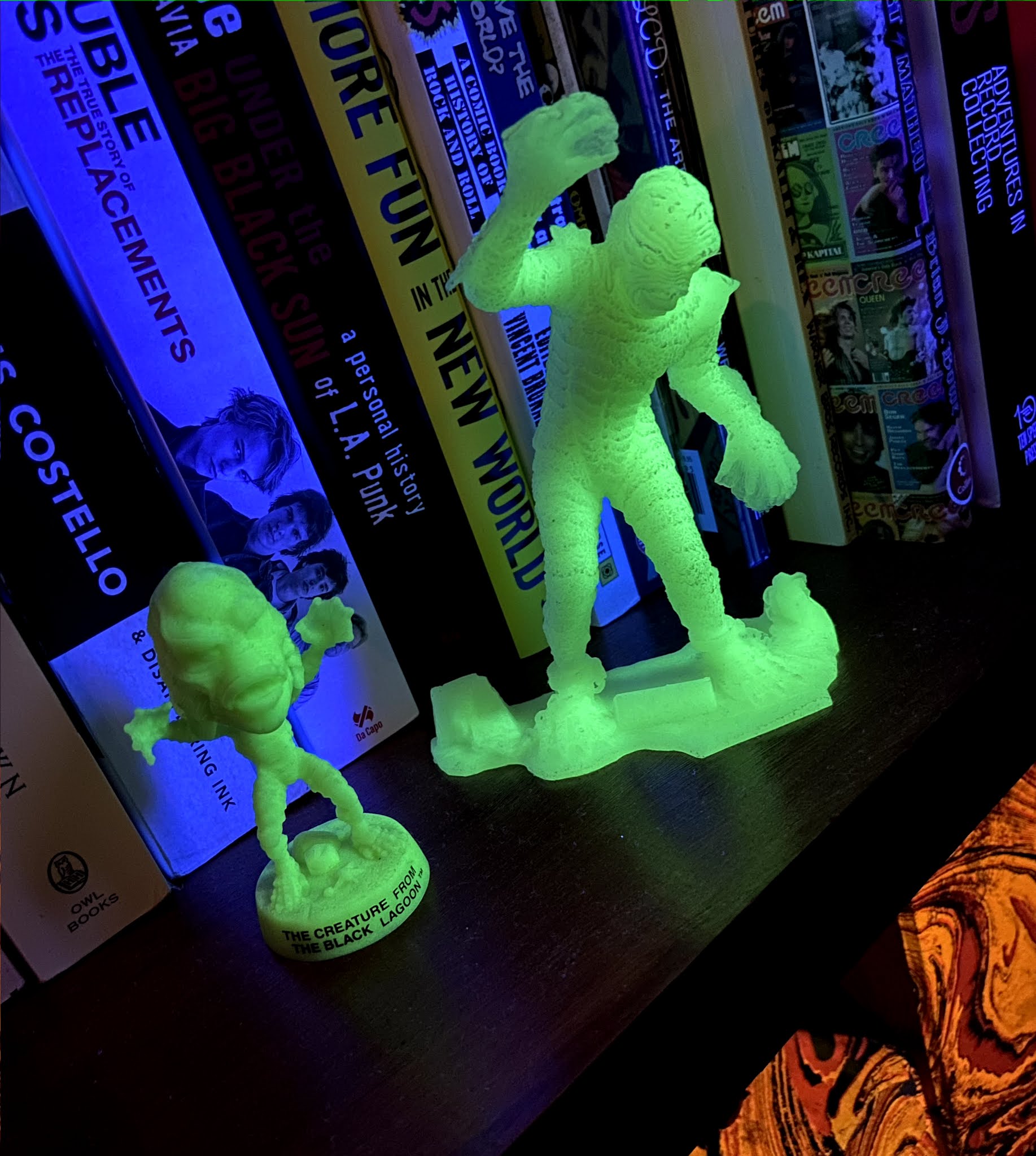
Other pop culture favorites that have been immortalized in fluorescence include the Creature from the Black Lagoon (love that 1963 Marx statue), Nosferatu (ReAction, 2018), and Alien (the Xenomorph figure and six pack of facehugger eggs both from NECA). 


I once had a friend comment on an Instagram post of my black light gallery that she would “never understand” my affection for this stuff. Which is fine, as I always say, it’s all subjective. And honestly, unlike my passions for Peanuts, Superman, Alfred Hitchcock, and Frank Sinatra (on which I could write dissertations), I can’t fully explain what it is about all things glow-in-the-dark that I find so appealing. Sure, part of it is nostalgia, but that’s not enough to make me put all this stuff on open display. Maybe it’s connected to my affinity for the kind of comforting mood lighting that makes me one of those people who spends too much money on candles and has Christmas lights strung in various parts of the house year-round. Who knows. But, as with everything that people collect, the reasons don’t matter. I’ll happily suffer the derision of those who don’t get it because ultimately, all that matters is… I like it. And isn’t that was collecting is all about? 


--------------------------

NOTE: This piece originally appeared on 13th Dimension as part of 2020's TOYHEM! series.


Sunday, November 29, 2020

PEANUTS POOC

The coincidence of Charles Schulz’ birthday falling on Thanksgiving 2020 is serendipitous as it reminds me that there are still things for which to be thankful in this most trying year. I’ve been thinking about Schulz a lot lately, as I just finished reading What Cartooning Really Is, Fantagraphics’ new collection of interviews with the late cartoonist, and fall and winter for me always incorporate seasonal Peanuts works, including comics, cartoons, and music. 

As part of my ongoing #POOC work (that’s Panels Out of Context, as seen here), I recently tackled some autumnal and winter-themed Peanuts panels, and discovered that as much fun as it is to redraw Charlie Brown and the gang on a nice summer day, it’s WAY more rewarding to put them in the setting of a chilly autumn early dusk, or (even better) a snowy, wintry day. When coloring panels that were originally black and white, I always use the classic animated specials, A Charlie Brown Christmas and It's the Great Pumpkin, Charlie Brown as a palette inspiration. Those incredible painted backgrounds created for the Lee Mendelson / Bill Melendez animated shows became as synonymous with Christmas and Halloween for me as Vince Guaraldi’s music and Charles Schulz’ own unique vision. 


I hope these pieces (which do incorporate the other seasons as well) are viewed as the affectionate homages they’re intended. Here's the legacy of Sparky Schulz, something about which I really need to write a lot more at some point. 


Note: The original version of this post appeared on 13th Dimension. 

Another note: Some of this artwork is available at my Etsy store, Tough Guy Goods. 


based on a drawing done for DC Comics publisher, Carmine Infantino